
How to Match an Embroidery Thread Color Across Brands
The design sheet says Isacord 1902. Your drawer holds Madeira, or Floriani, or a King Star cone you bought three machines ago — and you would rather stitch tonight than wait on a spool in the mail.
So you go looking for a conversion chart. And you find six of them, and they do not agree.
Why conversion charts disagree with each other
A conversion chart is somebody's opinion, typed up once and photocopied ever since. Usually it was made by holding two spools next to each other under whatever light was in the room that day, by a person with their own eyes and their own idea of how close is close enough.
Then it got scanned, re-posted, retyped with a digit wrong, and passed around for fifteen years while both companies quietly changed their color ranges.
None of that makes charts useless. It makes them a starting point that you still have to check with your own eyes — which is exactly the thing you cannot do when the spool is four hundred miles away.
What "closest" actually means
There is a real answer to how far apart two colors are, and it is not a matter of taste. Color scientists worked it out for paint and printing and textiles decades ago, and it comes down to one number, called delta E.
The idea is simple. Take a color's actual measurements, place it in a space built to match how human eyes work — one axis for light-to-dark, one for red-to-green, one for yellow-to-blue — and measure the straight-line distance between two of them.
The current formula for it, CIEDE2000, adds the corrections that make that distance line up with what people actually report seeing. It knows that we are fussier about small shifts in a soft blue than in a bright orange.
Once you have that number, "close" stops being a guess. It sorts into four honest verdicts:
- Near identical. You would not be able to tell them apart on a finished piece. This is a true substitute.
- Very close. You would see the difference if you laid the two spools side by side on a white table, and you would not see it in a stitched design.
- Noticeably different. The right family, a visibly different color. Fine for one leaf in a garden of leaves. Not fine for the second half of a two-spool gradient.
- Not a match. A different color that happens to have a similar name.
That last one is worth sitting with, because names are where most bad substitutions come from. Seventeen of the twenty-eight brands in our index sell a thread called Evergreen — in nineteen different colors, running from a clear bright green to a pine so deep it reads almost black.
Any one of them is the right answer to "I need Evergreen." Only one of them is the right answer to the design in front of you.
Do it with the colors in front of you
This is what we built Thread Match to do. It holds 9,270 thread colors from 28 brands — Isacord, Madeira, Floriani, Glide, Sulky, Robison-Anton, Marathon, Gunold, Hemingworth, Mettler, Coats & Clark, Gütermann, Aurifil, Brother and more — and it will rank all of them against any color you name.
You can start three ways:
- By number. Type 1902 and it finds the thread, then ranks every other color in the index against it, nearest first — including the neighbors in its own brand, which are very often the answer.
- By name. Type Evergreen and see every thread in every brand that goes by that name — which is an education in itself.
- By brand. Browse one company's whole range as a grid of real colors when you want to see what exists before you pick.
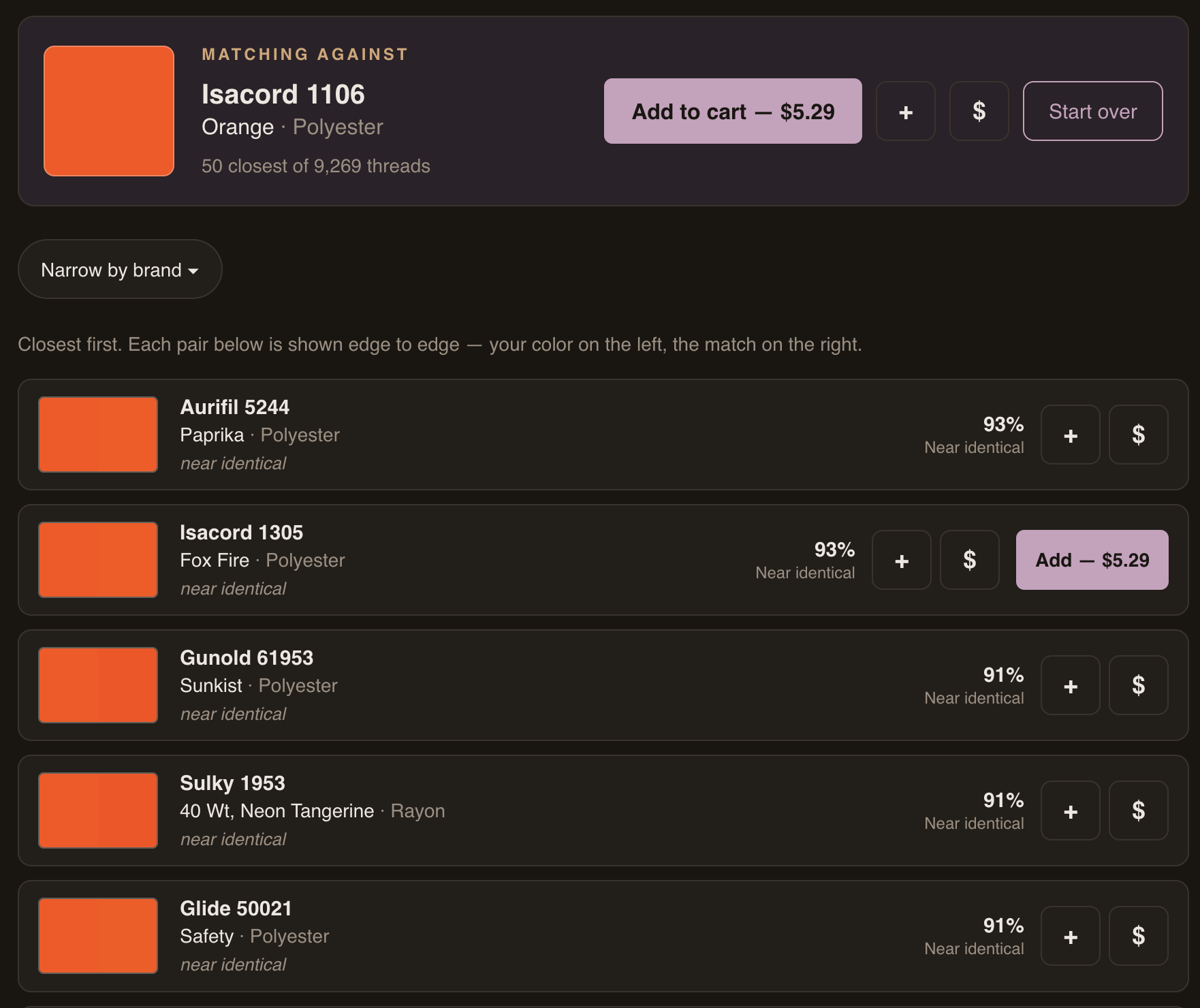
Every match is shown as two blocks of color meeting edge to edge, with no white gap between them, because a white gap is what makes two different colors look the same. The left side is the target color. Beside each pair is a match percentage and one of those four verdicts in plain words, so you never have to decide what a number means.

When the color you land on is one we carry, there is a button right there to add it to your cart, so finding the match and getting the spool can be the same trip.
And you can tell it what you own. Tick the brands that are actually in your sewing room and it remembers them, so every match from then on starts with the threads you can reach tonight instead of the ones you would have to order. Individual colors can be marked as owned or on your wish list the same way.
When a close match is fine, and when it isn't
A number tells you how far apart two colors are. It does not tell you whether the substitution is a good idea. That still depends on what you are stitching.
A close match is fine when the color stands alone — a single fill, a border, an outline, a monogram. Nobody is holding your finished piece up against the photograph on the pattern envelope.
Be careful when two colors have to work as a set. Shading a rose from light to dark, blending a sky, stitching the two halves of a face — those depend on the steps between the colors as much as the colors themselves. Substitute one thread out of a five-color gradient and you can flatten the middle of it. If you are going to substitute in a blend, substitute the whole run so the steps stay even.
Look at the fiber too. About seven in ten of the threads in our index are polyester, most of the rest are rayon, and a few hundred are cotton. Polyester is stronger and takes bleach; rayon has a softer, deeper shine. Put a rayon next to a polyester in the same design and the two will read as different colors under a lamp even when the measurement says they match, because one is throwing back more light than the other. Matching fiber matters as much as matching hue.
And check the neighbors in the brand you already own. People assume the answer has to come from another company, but very often the best substitute for a color you don't have is the color sitting two numbers away in the same range — same fiber, same sheen, same finish on the spool, and no surprises at all.
What to check besides the color
Once you have a candidate, three things decide whether it behaves:
- Weight. Most machine embroidery thread is 40 weight. A 30 weight lays down heavier and will fill a design faster than the digitizer planned; a 60 weight is for fine detail and small lettering. Swapping weights changes coverage, not just color.
- Fiber. As above — and if the finished thing will be washed hard or bleached, polyester is the safer answer.
- Sheen. Matte and high-shine threads of the identical color photograph as two different colors. If half your design is one and half is the other, you will see the seam.
When you do want the exact spool
Sometimes the honest answer is that nothing in the drawer is close enough, and the design deserves the color it was drawn for.
We stock most 422 Isacord colors on 1,000-meter spools at $5.29 each, and we will ship one spool as happily as thirty — plenty of orders here are a single number somebody needed to finish a project.
Right now there's a pleasant little surprise waiting when you add Isacord thread to your cart —